
Build Gordon's Backward Owner Timeline
Pull the newest deed that clearly matches the parcel you hold now. Write down the transfer date, both parties, the deed type, and the book/page cite. Then flip each name's role. Whoever signed as grantor had once been the grantee. Search that same name again on the earlier deed where the land was first acquired.
| Transfer date | Grantor to grantee | Deed type | Book/page |
|---|---|---|---|
| Newest matched deed | Prior owner to current grantee | As indexed | Capture exact reference |
| Earlier matched deed | Earlier owner to prior grantee | As indexed | Capture exact reference |
| Estate or court step | Decedent or estate to successor | Executor deed or order | Link probate and deed records |
| Historic book step | Indexed parties in old volume | Recorded conveyance | Use QuickLink and book image |
Treat the table as a working timeline built only from actual instruments. Every row needs a real deed behind it. If the lot, acreage, land lot, district, or adjoining owners fail to match, set that deed aside.
Gordon QuickLink Covers 1848-1993
The free Gordon QuickLink historic index opens around the clock. It covers index-book page images from 1848 through 1993. Fields include Type, Year, Parties, Last Name, and First Name. Search both party roles. Copy the book and page reference once you find a match.
QuickLink is half the job, though. It displays the historic index, not the deed itself. Take that book and page reference to GSCCCA or Kofile. Or ask the Clerk's deed room to pull the volume. Anything after 1993 lives in the current statewide system. It may also require an office request, since no official current start year was published for Gordon County.
The official historic-index page lists its entry point plainly. Open the QuickLink source and review the available fields before searching.
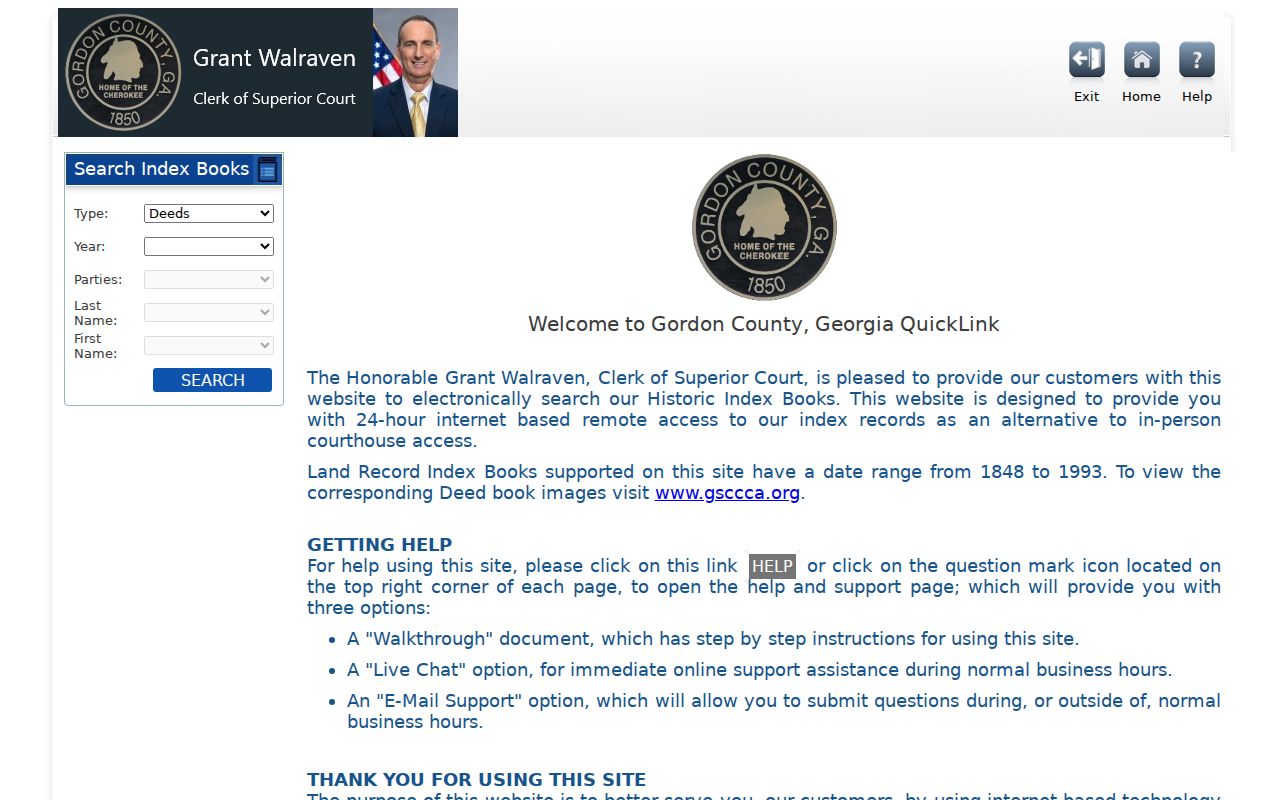
The real value here is the local year and party controls. A matched row still needs its deed-book image and a legal-description check before it joins the chain.
Reverse Gordon's Grantor-Grantee Chain
Names swap roles as the timeline deepens. A buyer shows up as grantee on the acquisition deed. When that owner later sells, the same name appears as grantor. Work from the certain recent deed into murkier history. Preserve every reference along the way.
- Find the current grantee's acquisition deed and verify the land description.
- Copy the grantor name, transfer date, deed type, and book/page.
- Search that grantor as a grantee in an earlier date range.
- Repeat until QuickLink ends, then continue in the cited deed books and archives.
- Grantor
- The party conveying an interest.
- Grantee
- The party receiving the stated interest.
- Chain of title
- The ordered series of instruments affecting the same land.
- Reverse index
- An index arranged by grantee or receiving party.
- Quitclaim and warranty deed
- Different conveyance forms whose legal effect should not be inferred from the index alone.
Match Gordon Land, Not Names
A common surname invites false hits. Compare the subdivision, lot, block, land lot, district, acreage, roads, creeks, adjoining owners, and prior deed references. Do not trust the name alone. A modern street address may simply never appear in an early instrument. The deed description is what keeps former owners tied to one tract.
Gordon parcel IDs arrive spaced or hyphenated. A split can replace a parent number with several child numbers. Keep every format on file. Do not force a modern ID onto an old deed unless the record itself supplies the cross-reference. Lean on recorded plats for lot-and-block land.
Probate Can Bridge Gordon Owners
A timeline can look like it dead-ends when a recorded owner dies. Gordon Probate Court estate files may hold inventories and appraisals. They can also carry petitions to sell land, returns on sale, orders for division, and heir receipts. Search under the decedent and the estate. Try the executor, the administrator, the surviving spouse, and the heirs alike.
The bridge back to the land chain is still a recorded deed or order matching the property. A death certificate proves the event, not the title. Georgia Archives identifies Gordon estate and will material from 1864 through 1920. That helps when the local chain reaches into the nineteenth or early twentieth century.
Gordon Record Loss Needs Fallbacks
Georgia Archives notes Gordon County record-loss events in 1864 and 1888. The first courthouse, built in 1852, fell to the 1888 storm. That history does not mean every deed vanished. Surviving books and copied indexes can preserve much of the trail. Tax rolls, probate files, plats, and newspaper notices help too.
Use the Archives county-card finding aid to identify surviving series. Then move to county microfilm and FamilySearch. Record the last confirmed owner. Note the missing year or book, the collection searched, and the next request. A documented gap beats an unsupported claim that no earlier owner ever existed.
The Georgia Archives county-card screen is the official finding-aid entry point.
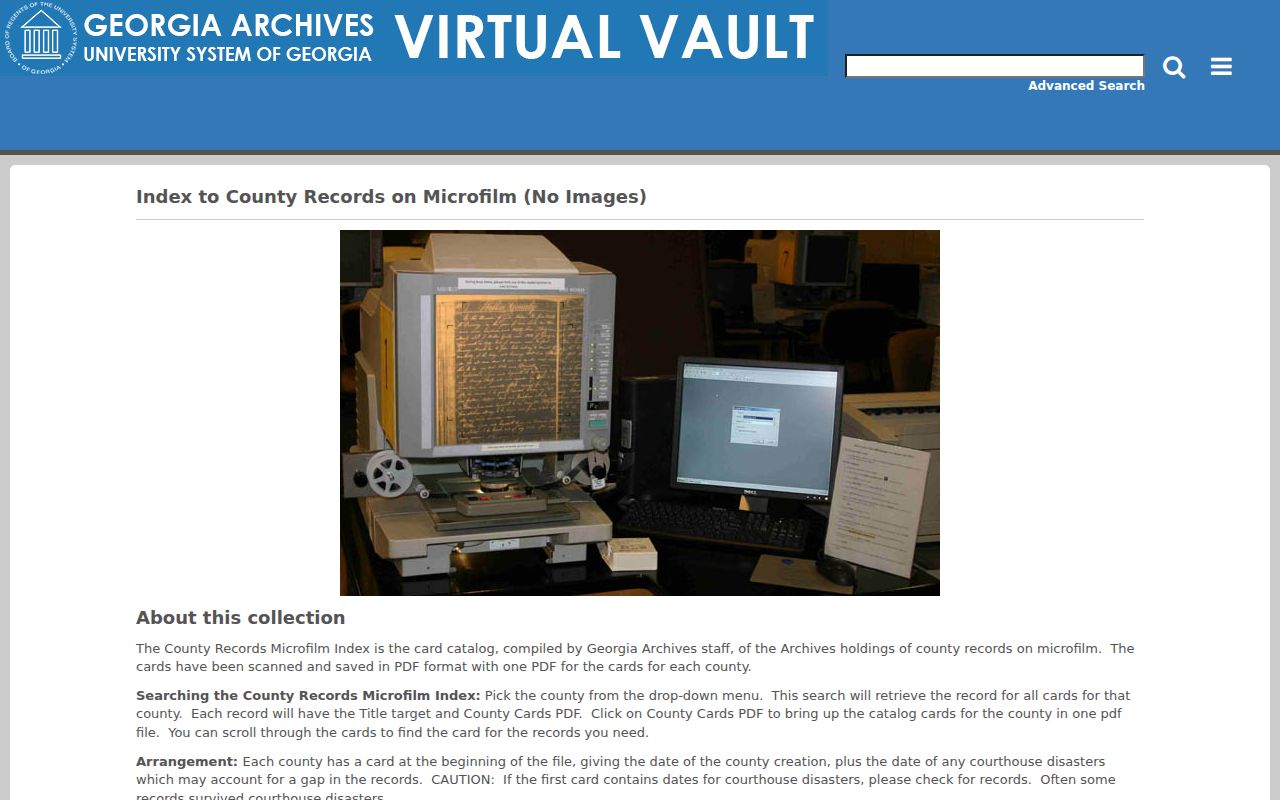
The county selector helps flag surviving record series before any move to deed-book images or an archive request.
Note: Gordon's 1848 index start predates the county's 1850 creation, so predecessor-county context may matter for the earliest entries.
Tax Digests Support Gordon History
Tax digests can pin a name to taxable land in a given year. This helps when the deed index turns up nothing obvious. The county's online digest archive lists recent years. The Georgia Archives county microfilm collection carries older tax, deed, and probate material. A digest entry supports the story; it does not convey anything.
Historic newspapers add legal notices, sheriff sales, estate notices, and subdivision advertisements. The Digital Library of Georgia's Gordon obituary collection spans local clippings. It may explain a probate transition. Match every clue back to a recorded instrument whenever you can.
Old Gordon Addresses Can Mislead
A mailing address does not equal a location. Calhoun, Resaca, and Fairmount postal names stretch past their city limits, so an address alone can mislead. Older legal notices compound the problem. They may describe a parcel by I-75, U.S. 41, U.S. 411, a railroad, a creek, a mill, or a road name that no longer appears on maps.
Start with the current parcel instead. Pull its land lot, district, subdivision, plat, and adjoining-owner clues, then work backward through the deed records. Gordon County was carved from Cass (later Bartow) and Floyd lands, so the earliest former-owner searches may reach into predecessor property records. Address history can guide the chain of title, but the recorded deeds themselves must anchor it.
How Far Gordon Owner Records Reach
An online search only reaches what its index covers. QuickLink offers a clear historic run from 1848 through 1993. GSCCCA carries current statewide deed records, though it publishes no Gordon-specific start date. Older volumes may sit in browse-only microfilm. They may also rest with the Clerk, the Archives, or FamilySearch rather than in a searchable name index. Stop at the last verified instrument, not at the last name a website returns.
Historic use. Research former Gordon County owners for house history, estate work, or land diligence. Never use a living person's record to stalk, harass, or cause harm.
Where reliance matters, the recorded deed image and a certified county copy outrank any index transcription. A professional title examination may still be needed. For a single recorded instrument and copy options, use the Gordon County deed records page.
Read Gordon Chain Breaks Carefully
A name search returns instruments that never transferred land. A security deed only secured a debt. An assignment moved the secured party. A cancellation or release cleared an earlier claim. A corrective deed can repair a name or legal description without marking a market sale. A quitclaim may pass along only whatever interest its grantor held. Classify every document before it earns a place on the former-owner timeline of the parcel.
Unusual steps often make sense in court and lien records. A quiet-title decree, partition order, foreclosure file, tax deed, or lis pendens may appear in the chain. Each one may point to the next recorded instrument. Probate records can show an executor or administrator acting for an estate. That context helps. But the matched deed, order, or sale instrument is what anchors the transfer to the parcel number.
Keep a Gordon Chain Research Log
Log every prior owner carefully. Record the exact indexed name, party role, date range searched, instrument type, book and page, image source, and legal-description match. Add alternate spellings, entity punctuation, spouse or co-owner names, and any parent parcel number. When a search returns nothing, note whether QuickLink, GSCCCA, the Clerk, Archives microfilm, FamilySearch, probate, tax digests, and newspaper notices were each checked. Check each source in turn. QuickLink comes first. GSCCCA follows. The Clerk, Archives microfilm, and FamilySearch come next. Probate, tax digests, and newspaper notices finish the sweep.
This log matters most near the 1864 and 1888 record-loss periods. It separates a true surviving gap from a missed spelling, a browse-only volume, or a record still sitting in a predecessor county. A missed spelling is common. A browse-only volume hides records from indexed search. Some records still sit in a predecessor county. The log also makes the ownership history reproducible. A later reader starts at the last firm deed instead of repeating the whole search. That spares them from reading an index silence as proof the land had no prior owner of record. An index silence proves nothing.