
Gordon Property Tax Record Fields
Two offices split Gordon County property tax records. The Board of Assessors sets fair-market and assessed values. It also keeps parcel data current and runs the exemption programs. The Tax Commissioner sends out the tax bill, takes payments, and pursues delinquent accounts. Carry the parcel number and tax year with you whenever you move between the two.
| Field | What It Shows | Where |
|---|---|---|
| Fair-market value | Assessor's estimate of full value | Board of Assessors parcel card and notice |
| Assessed value | Georgia's taxable assessment base before exemptions | Board of Assessors |
| Exemptions | Homestead or other approved relief codes | Board of Assessors |
| Bill and payment status | Amount billed, paid, due, or delinquent | Tax Commissioner |
| District and levy | Tax jurisdiction and applied rate | Tax bill and annual levy records |
Georgia law generally taxes property at 40 percent of its fair-market value. Exemptions and special programs can shrink the taxable base further. Remember that a tax bill is not an appraisal. Neither number equals a recorded sale price. Check the dates and labels on every figure before you rely on it.
Gordon Assessor Search Keys
The Gordon QPublic search is the public gateway to the assessor card and parcel map. County-linked materials describe search modes by owner name, property address, and parcel number. Read the labels on the screen as they appear rather than guessing at wording.
| Input | Best use | Check on the result |
|---|---|---|
| Owner name | Find parcels on one roll account | Exact entity spelling and co-owner lines |
| Property address | Locate a known situs | Postal city may differ from jurisdiction |
| Parcel or map number | Match one tax account | Keep spaces or hyphens shown by the source |
| Map click | Open a parcel report | Tax district, value, acreage, and layer date |
A parcel report may list land, improvement, fair-market, assessed, and taxable values along with exemptions and last-sale fields. Blank fields deserve a quick call to the assessor.
Gordon's Forty Percent Assessment
The Georgia Department of Revenue valuation page lays out the statewide 40 percent assessment level. Picture a Gordon parcel with a fair-market value of X. The ordinary assessed value starts at 40 percent of X. Exemptions or special assessments can then change that figure. Current-use, conservation-use, preferential agricultural, and other approved programs can skew a simple comparison.
Each value has its own job. Fair-market value is the assessor's estimate under Georgia law. Assessed value is the statutory share used in the tax calculation. Taxable value reflects adjustments that hit the account. The millage rate then converts that taxable base into the tax due. A mill equals one dollar of tax per thousand dollars of taxable value.
- Fair-market value
- The assessor's estimate of full property value.
- Assessed value
- The statutory assessment base, generally 40 percent in Georgia.
- Homestead exemption
- Approved relief tied to a qualifying primary home.
- Millage
- The rate applied per thousand dollars of taxable value.
- Tax lien
- A public claim tied to unpaid property tax.
Find a Gordon County Tax Bill
The Tax Commissioner keeps the bill, payment, and delinquency side of Gordon County property tax records. Grab the assessor's parcel key first. Then head to the official payment landing page. Write down the date you checked, since balances shift with payments, interest, corrections, or appeal outcomes.
- Find the parcel and tax year on QPublic, then copy the displayed account key.
- Open the Tax Commissioner's provider and match the same parcel and owner.
- Read the current bill, payment status, levy, and any available prior-year entries.
- Compare exemptions on the assessor card and call the office about an appeal, old bill, or tax-sale claim.
Paying online by card adds a 2.50 percent convenience fee. The Tax Commissioner cautions that the displayed balance may leave out a pending appeal. Delinquent bills and records older than seven years require a direct call to the office.
Appeals Can Change Gordon Balances
An online amount is not always the last word. A pending assessment appeal may never reach the payment screen, and the tax year on a bill may lag behind a new deed or parcel change. Keep the assessment notice, appeal acknowledgment, bill, and payment receipt in one file.
The Tax Commissioner's payment disclaimer spells out these limits on the county site.
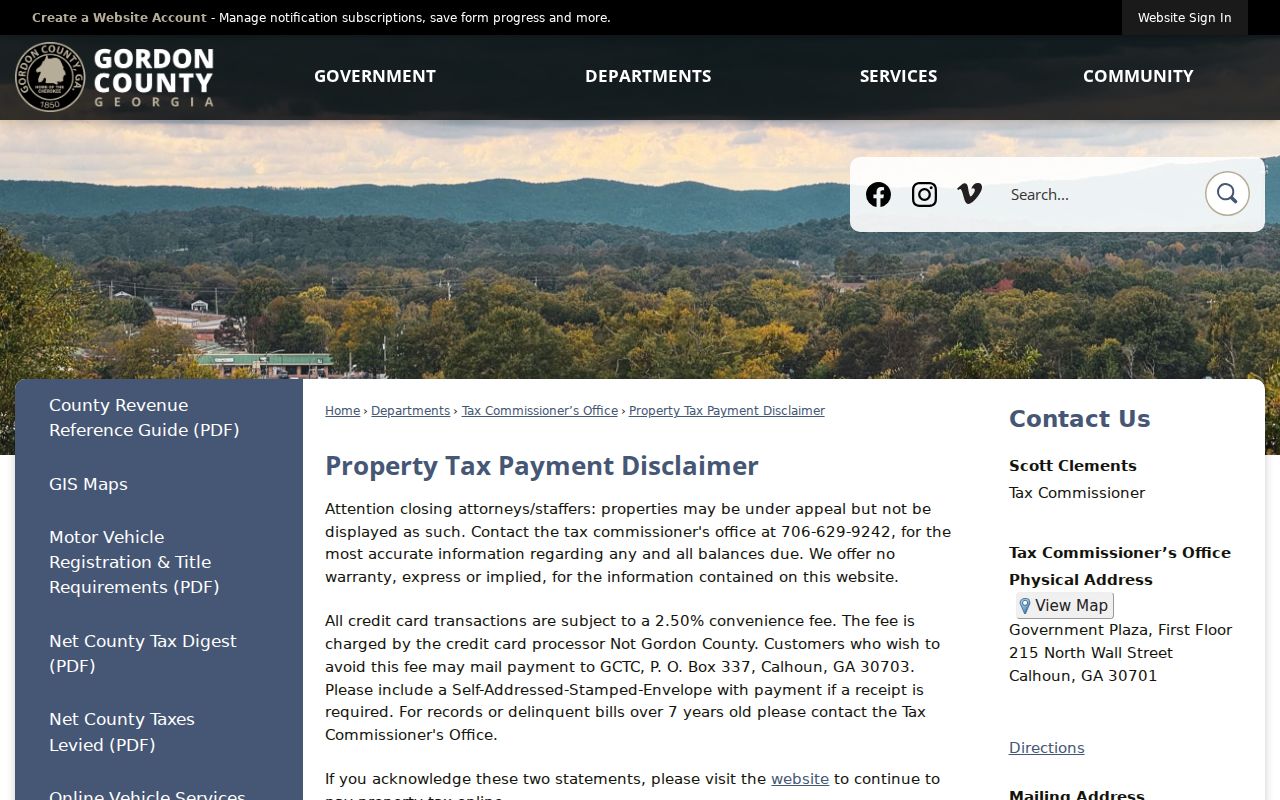
That warning is a reminder. Any Gordon County property tax lookup should end with an office call when an appeal or an old balance matters.
Gordon Homestead and Land Programs
The Gordon assessor exemption page covers homestead plus state and local programs. These include senior, disabled-veteran, surviving-spouse, conservation-use, current-use, preferential agricultural, and Freeport categories where their rules apply. Every program sets its own ownership, use, filing, and proof requirements. Never infer eligibility from a code alone.
Homestead usually renews automatically while the same owner stays eligible. An ownership change can force a new application. Assessor materials tie timely homestead filing to the current assessment cycle and appeal window. The downloadable forms page carries current applications. A transfer or use change warrants a call to the office.
Note: An exemption trims the taxable base. It does not rewrite the deed or prove who holds title.
Gordon Tax Calendar in 2025
County materials sketch a firm 2025 sequence for Gordon County: assessment notices arrive on June 17, and the appeal deadline lands on August 1. The digest goes in on September 1. October brings the bills. Payment comes due in December. Those dates describe one cycle, not a permanent calendar. Check each year's notice and county alerts for the real deadline.
The schedule also explains why records disagree. Each record carries its own date. The assessor files the annual notice, the Tax Commissioner issues the bill, and a newly recorded deed lands in its own window. A parcel transferred after the notice may hit the Clerk's deed index first. The tax roll or bill catches up later.
Gordon Digest and Levy History
The county tax digest archive lists annual digests and five-year levy histories. Coverage spans 2016 through 2025. These reports shine for countywide context, like digest growth, exemptions, and levy decisions.
They will not match the detail of a single parcel card. They also will not prove what a home sold for.
Use the year list to trace how county tax policy has shifted over time. Leave parcel-level claims to QPublic and the bill.
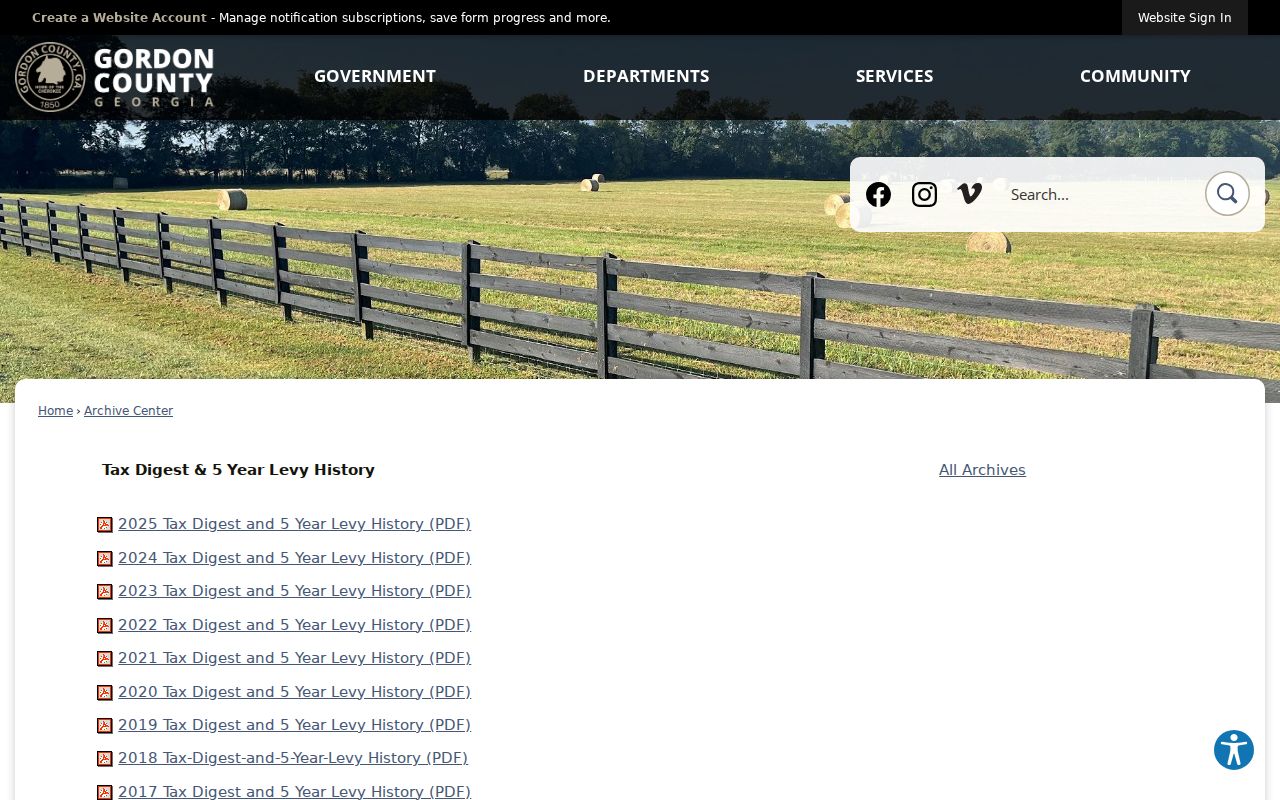
The year list lets you compare Gordon County tax policy over time, while parcel-level figures stay tied to QPublic and the bill.
Old Gordon Tax and Sale Records
A late bill and a tax sale are different animals. An unpaid balance is only the first stage of several. Start with the Tax Commissioner for the current balance and status. Then move to the Clerk for fi fas, executions, releases, liens, and tax deeds. A Superior Court file or a published legal notice may fill in procedural gaps.
Older balances need a phone call. For any delinquency more than seven years old, call the Tax Commissioner at 706-629-9242. Write down the tax year and the parcel. Note the date of inquiry and the answer you receive. The office page names the Tax Commissioner as the collector for about 28,000 property bills. It also lists the current contact route.
Contest a Gordon County Assessment
Georgia gives owners 45 days from the date on the annual assessment notice to file an appeal with the Gordon County Board of Assessors. Use the current appeal form and the instructions printed on the notice. Comparable sales, photographs, repair details, corrected building facts, a recent appraisal, deed and plat facts, or a clean explanation of an exemption problem all count as evidence. The path depends on the notice. The Board of Equalization is one route, and the Clerk supports it. The Georgia DOR property-tax page links the PT-311A form and statewide rules, while Gordon's forms page carries local materials. Keep proof of timely filing and every written decision.
Read the annual notice line by line first. Check land and improvement values, acreage, building facts, use class, tax district, exemptions, and prior values. Pull the deed and plat too. A parcel may have changed shape or ownership since the last roll. A recent sale can serve as evidence. Be careful, though. A family transfer, foreclosure, partial interest, or nominal price may not reflect market value. Value disputes and bill issues travel on separate tracks. The Board of Assessors decides valuation, classification, and exemptions, while the Tax Commissioner handles billing and collection. Sending an appeal to the payment provider preserves nothing. Paying a bill does not fix the roll.
Countywide questions about Gordon County property tax records point to the digest and levy records. Gordon's archive holds annual digests and five-year histories from 2016 through 2025, and the county reported a 9.042 millage rate for 2024 and 2025. Treat that figure as history, not a promise. Delinquency moves in stages. A bill goes unpaid, an execution or fi fa issues, notice publishes, a sale is scheduled, then completed, then redeemed or deeded. A parcel can stop at any point. Ask the Tax Commissioner for status and search the Clerk for executions and releases. Check the court file when one exists.
A recent sale can leave Gordon County property tax records looking inconsistent. The deed records before QPublic updates its owner field. Notices and bills follow their own calendar, and Gordon promises no closing-to-roll delay. State both dates. The newest recorded deed wins. Save the parcel card, notice, appeal proof, decision, bill, receipt, and any execution or release, marking the tax year and retrieval date. If a portal is blank, call the assessor or Tax Commissioner and record the answer, so a stale balance never gets repeated as current.
Appeal window. File within 45 days of the notice date, not from the bill date. Confirm the exact Gordon County deadline on the notice.