
Gordon County Deed Instruments
Gordon County deed records trace every land transfer filed with the county recorder. Some parcels are fresh subdivisions. Others first appear in hand-kept index books. Each Gordon County deed names a grantor and a grantee. It also describes the land and fixes a recording date that anchors the chain of ownership. A complete property search pairs that deed with plats, liens, releases, and court orders that color the story. Search Gordon County property records by address to start, then follow book and page references backward. Older records live in index books. A full chain may need both online property records and a request to the Clerk.
| Deed Type | What It Does | Common Use |
|---|---|---|
| Warranty deed | Conveys the stated interest with title covenants | Ordinary arms-length transfers |
| Quitclaim deed | Conveys only the interest the grantor has | Family, corrective, or claim-clearing transfers |
| Executor or administrator deed | Conveys land through an estate representative | Probate-authorized transfers |
| Security deed | Secures a debt against described real estate | Financing, followed by release or assignment records |
| Tax or sheriff deed | Records a transfer after an official sale process | Distressed-property chains requiring added review |
Not everything indexed beside a conveyance acts like one. A security deed, assignment, lien, release, plat, or lis pendens may sit near the deeds but serve a different purpose. Track the instrument type alongside the legal description. A cancellation resolves a security deed, and a later corrective deed can repair a name or land description without signaling any market sale.
QuickLink Opens Gordon's Old Index
The Gordon QuickLink historic index is free and open round the clock. It reaches index-book pages from 1848 through 1993. Its starting year predates Gordon County's creation in 1850. So early results may reflect predecessor-area indexing. Searchers can choose an index series, year range, name terms, and page ranges. Then inspect the scanned index page for the deed-book reference.
The index page is only the first half of the search. It is not usually the deed image itself. Copy the book, page, party spelling, and instrument clues exactly. Then use GSCCCA or Kofile to obtain the related book image. Or give those facts to the Clerk. This two-stage route prevents a common error. It stops searchers from treating an index line as the full recorded instrument.
The official QuickLink portal opens straight into the historic index entry point. Open Gordon QuickLink to see the historic search screen.
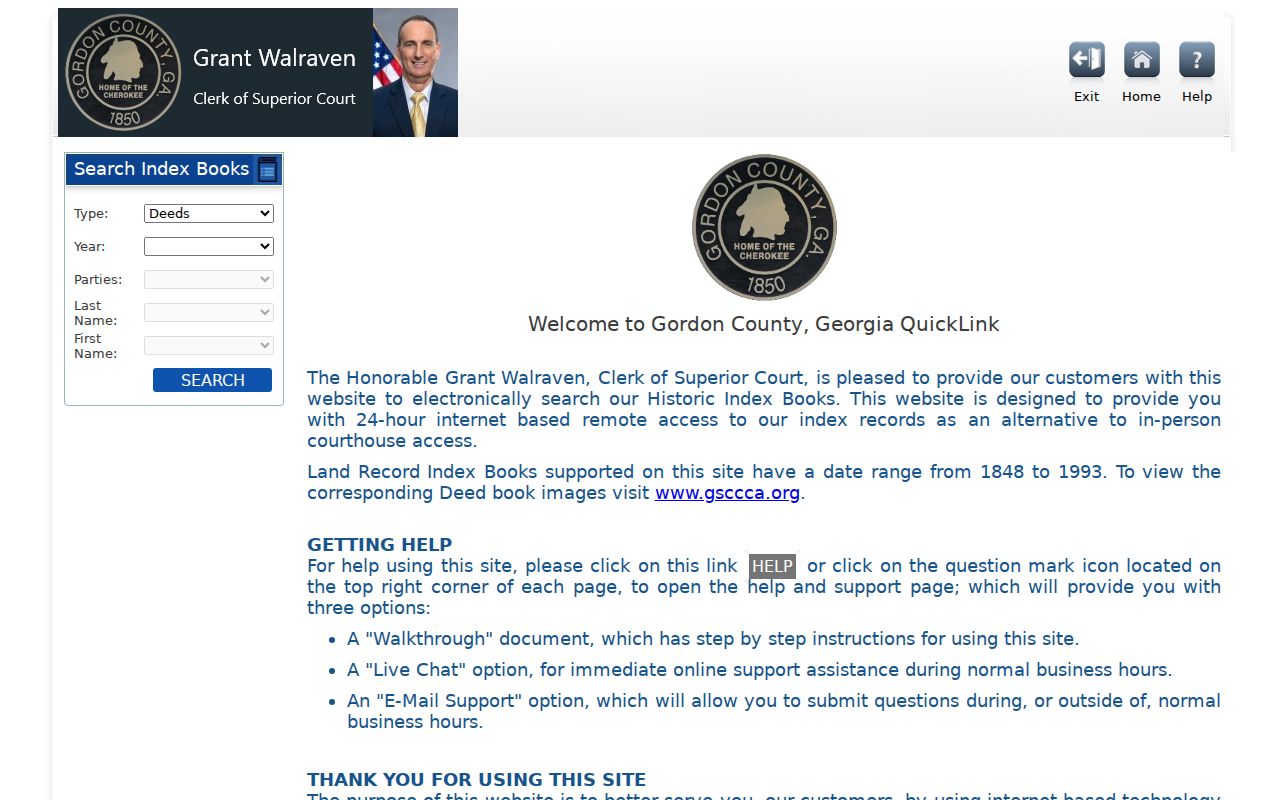
The QuickLink screen shows where Gordon County deed records start online. It explains why the old book-and-page system hands off to the new index.
Search Fields for Gordon Deeds
Modern and historic platforms share search keys, though their screens differ. The GSCCCA real-property system handles grantor and grantee queries. It also covers instrument, book/page, subdivision, lot, address, map, plat, lien, and PT-61 searches. Some advanced options or images need an account. Narrow a date range only after confirming the deed could fall inside it.
| Search key | Use in the deed index | Practical check |
|---|---|---|
| Grantor or grantee | Finds transfers by party name | Try initials, spouse, estate, trustee, and entity variants |
| Book and page | Opens a cited volume reference | Retain leading zeros and the source index year |
| Instrument type | Narrows deeds, liens, plats, or releases | Do not assume every indexed item conveys title |
| Subdivision, lot, or map | Connects a plat-based description | Match lot and block to the parcel card |
| Address or PT-61 | Supports modern sale searches | Premium access rules may apply |
Gordon County publishes no exact start year for its current online coverage. A blank result calls for a call to the Clerk, not a conclusion that no deed exists.
Gordon Grantor-Grantee Trail
A chain of title is the ordered run of deeds touching one piece of land. Gordon County deed records index each transfer twice. The grantor gives the interest, and the grantee receives it. Names alone will not carry the search. Confirm every candidate deed by legal description, acreage, lot and block, land lot or district, prior book reference, and parcel clues. Match the parcel clues too.
- Find the newest purchase or transfer deed with the current roll owner as grantee.
- Read its grantor, legal description, and prior deed citation.
- Search that grantor as an earlier grantee, then match the same land.
- Repeat, moving to QuickLink books, the Clerk, or archives when the online system ends.
- Grantor
- The party that transfers the stated interest.
- Grantee
- The party that receives the stated interest.
- Chain of title
- The linked sequence of instruments for the same land.
- Book/page
- A volume and page citation used to retrieve a recorded image.
- Instrument number
- A unique filing reference used by a newer index.
Gordon Deed Books After Record Loss
Georgia Archives lists Gordon County record-loss events in 1864 and 1888. The first courthouse, built in 1852, fell to a severe storm in 1888. Gaps are possible. That history never means every deed book vanished. The Archives county cards, the QuickLink run, and surviving courthouse books show substantial material remains.
Bridge a gap with the Georgia Archives county-record cards. Then check county microfilm, FamilySearch browse images, predecessor-county records, tax digests, probate files, and newspaper legal notices. Note the last confirmed instrument and the missing book. When a modern address dead-ends, try a different angle. Searching a prior owner, road, creek, district, land lot, or adjacent owner often works.
Note: A courthouse disaster date is a research clue, not proof that a particular Gordon deed was destroyed.
Gordon Liens and Releases
Deed research should reach beyond deeds. Search security deeds, assignments, modifications, cancellations, mechanic's liens, fi fas, tax executions, lis pendens, easements, rights of way, UCC fixture filings, and plat references under the same owner and entity names. A clean assessor card says nothing about the lien docket.
A recorded claim may carry a later release under a creditor's changed name. Compare book/page or instrument number, debtor, secured party, land description, and release reference across both filings. Use the same owner and entity names. In a dispute, the Superior Court file may explain the status. The release, order, or deed should still appear in the Clerk's property records.
FANS Watches New Gordon Filings
Georgia's Filing Activity Notification System (FANS) sends alerts. When the Clerk transmits real-estate, lien, plat, UCC, or PT-61 index data, FANS can match it against a registered name or address. Registering alone starts nothing. You must create at least one alert. Name matching turns on indexed spelling, and address alerts skip post-office boxes.
FANS does not backfill history, guarantee complete or immediate notice, or run past one year without renewal, and it suits watching your own authorized property rather than researching others. A notice is a prompt, not proof. Use it to inspect Gordon County deed records and contact the Clerk, not to assume fraud or a title defect.
Gordon Plats and Easements
A Gordon County deed can describe land several ways. It may cite a subdivision and lot and block, or run metes and bounds tied to roads, creeks, land lots, districts, and adjoining owners. For a plat, search the GSCCCA Plat Docket using the deed's plat name and book/page. Read the dedications, easements, revisions, replats, and vacation notes. A later lot split or annexation can change the parcel number without breaking the older deed chain.
The parcel map orients your search. It is not a survey. For a boundary or access dispute, compare the deed description, the recorded plat, the easement instrument, and a current survey by a qualified professional. The Clerk records documents but gives no legal advice.
Order a Gordon County Deed
The Gordon County Clerk of Superior Court records deeds at 101 South Piedmont Street in Calhoun. Office hours run 8:30 a.m. to 5:00 p.m. on weekdays, and the phone is 706-629-9533. When ordering, give the party names, instrument type, and record date. Add the book and page or instrument number. Say whether you need a plain or certified copy. Requests work through online image access, at the counter, or by asking the office about mail service.
Copies carry set fees. The county services and fees page lists unassisted copies at $0.50 per page and assisted copies at $1 per page. A certification stamp adds $2.50. GSCCCA access follows its own account and image rules, including single-use and subscription options. Confirm the current total before paying.
Mail and counter requests still matter. Include grantor and grantee names, a likely year, and the instrument type. Add a description clue and the book and page. Ask where archived series are stored and whether an index or copy can be produced. The Clerk can certify a copy but cannot judge whether it created good title.
Chains of title often branch. Probate, merger, foreclosure, correction, and life-estate language each leave their own paper trail. Search an estate under both the decedent and the personal representative. For an LLC, compare its exact name against Georgia eCorp, then search current and former entity names. A registered agent is not a beneficial owner, and a business record never replaces the deed itself.
Old descriptions read differently. They may rely on district, land lot, road, creek, rail line, acreage, or adjoining owners. Modern addresses can be far newer. Match the parcel to the plat or parent tract, then carry the old terms backward in time. Newspapers, tax digests, probate files, and library collections can bridge a gap. Any title conclusion, though, returns to a recorded instrument.
Read every copy in context. Note the execution and recording dates. Look for grantee capacity, consideration wording, prior deed references, reservations, exceptions, easements, and exhibits. Then check for a corrective deed, release, or replat that changes the picture. A PT-61 sale value can aid review, but it never replaces the deed terms.
No hits? Vary the search. Drop punctuation, try middle initials, and add a spouse or co-owner. Test estate or trustee wording. Broaden the date range and search both index directions. For a company, run former names as leads. Always match the land, since one name can appear on unrelated Gordon County parcels.
A complete research note states the source, access date, spelling, type, and recording date. It also covers the citation, description match, and copy status. Note: it also lists what was not checked. That separates a reproducible search from an unsupported claim that the chain is clear.
Recorded, not guaranteed. Gordon County deed records show filed instruments, not every unrecorded interest or a title opinion. Seek a Georgia title professional for legal assurance.